
Security: who sees which known issues
No portal response ever contains a known error the requesting user's organisation is not entitled to see. Everything below serves that sentence.
Kenvara is a known error database for Jira Service Management, built on Atlassian Forge. This page says how it decides what a customer may see, what the app asks for, and what it records.
The rule, in plain words
- Default deny. A record is shown only when every condition holds. Anything unknown — a lookup that failed, a caller type that is not recognised, a missing field — means hidden.
- Identity comes from the request's own context, which Atlassian signs, never from the page, the payload or anything the browser can change.
- Organisation membership is resolved for each call, or from a short cache whose length the administrator sets. A failure hides the record rather than showing it.
- A licence can only remove what a customer sees. It never adds. While Kenvara's licence is not active, the portal shows nothing from it, and every control that only switches something off still works. Security is never the paid part.
- The three negative answers are identical. Not linked, not found and not entitled read the same, so a customer cannot tell which it was.
- The portal is told nothing extra. No organisation list, no internal fields, no sequential keys, and no count of what was hidden.
Organisations and MSPs, in the guide, and the cloud security statement.
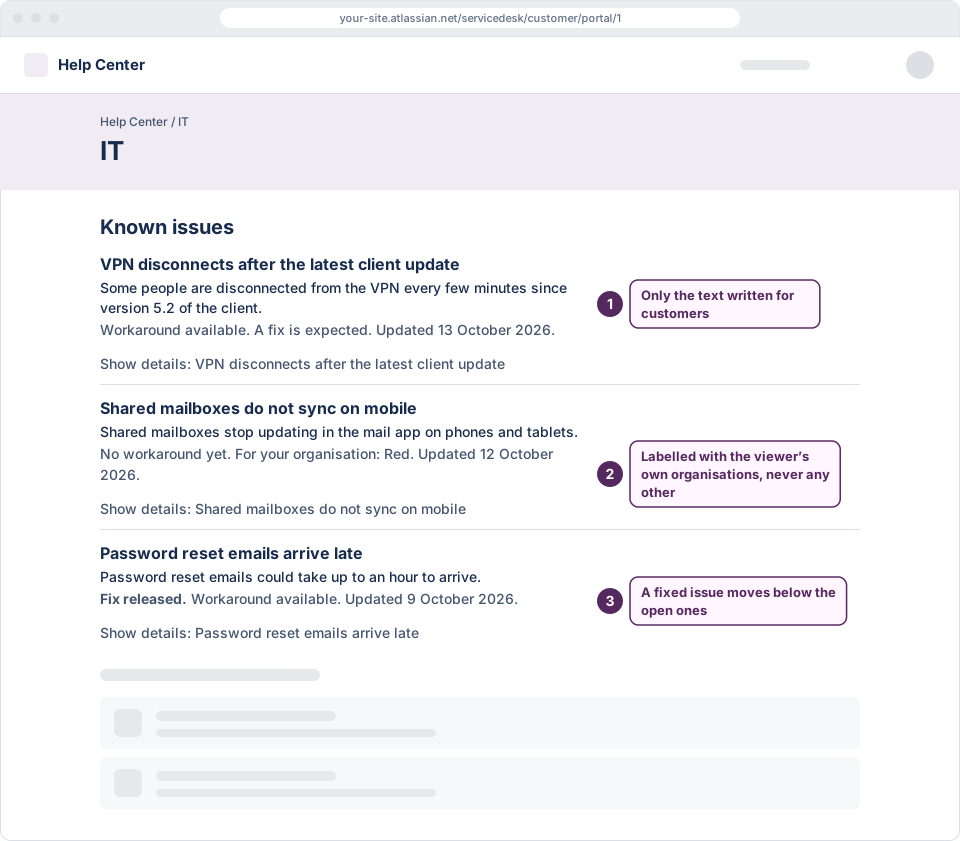 (opens the full-size illustration)
What the app asks for
Generated from the app's own manifest when the site is built, so this list is what the app actually declares.
| Scope | Read or write |
|---|---|
read:jira-work | Read |
read:organization:jira-service-management | Read |
read:servicedesk-request | Read |
read:servicedesk.organization:jira-service-management | Read |
read:servicedesk:jira-service-management | Read |
report:personal-data | Report |
storage:app | The app’s own storage |
write:jira-work | Write |
write:project.property:jira | Write |
write:servicedesk-request | Write |
No outbound calls. The app declares no external permissions and makes no request to any host but Atlassian's own APIs (none declared), which is what keeps it eligible for Atlassian's own hosting guarantees. Its Kenvara on the Atlassian Marketplace carries Atlassian's Runs on Atlassian badge, which Atlassian gives apps that run on its platform and send no data outside it.
Acting as the app. Most work is done as the signed-in person. The app acts as itself only where that person provably cannot read what the app must, and those places are a fixed list of 7 files, held by a test that fails if another file is added.
Workarounds go as replies only for known errors published to all customers
Kenvara does not post a workaround as a reply on a request when its known error is limited to particular organisations. A reply reaches everyone who can see that request, and Kenvara does not check each of them. The workaround appears on the portal, where the check is made for the person reading it.
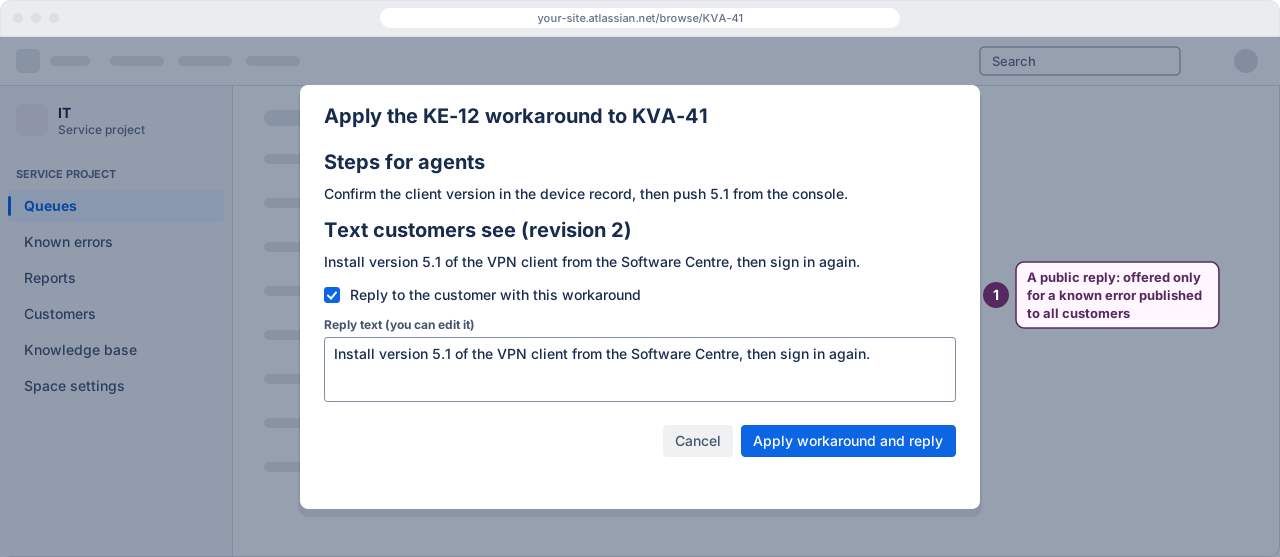 (opens the full-size illustration)
What the portal records
While Kenvara's licence is active, it counts, for each known issue, how often it was shown and opened and how readers answered. The counts identify no one: daily figures are kept for 90 days, then as monthly totals. Each answer is also kept for 30 days with a one-way code in place of who gave it, so that repeated presses by one person are counted once; after that only counts remain. Nothing is sent outside Atlassian. While the licence is not active, nothing is recorded.